Blood in the Machine
Book club discussion to be held on Oct. 21
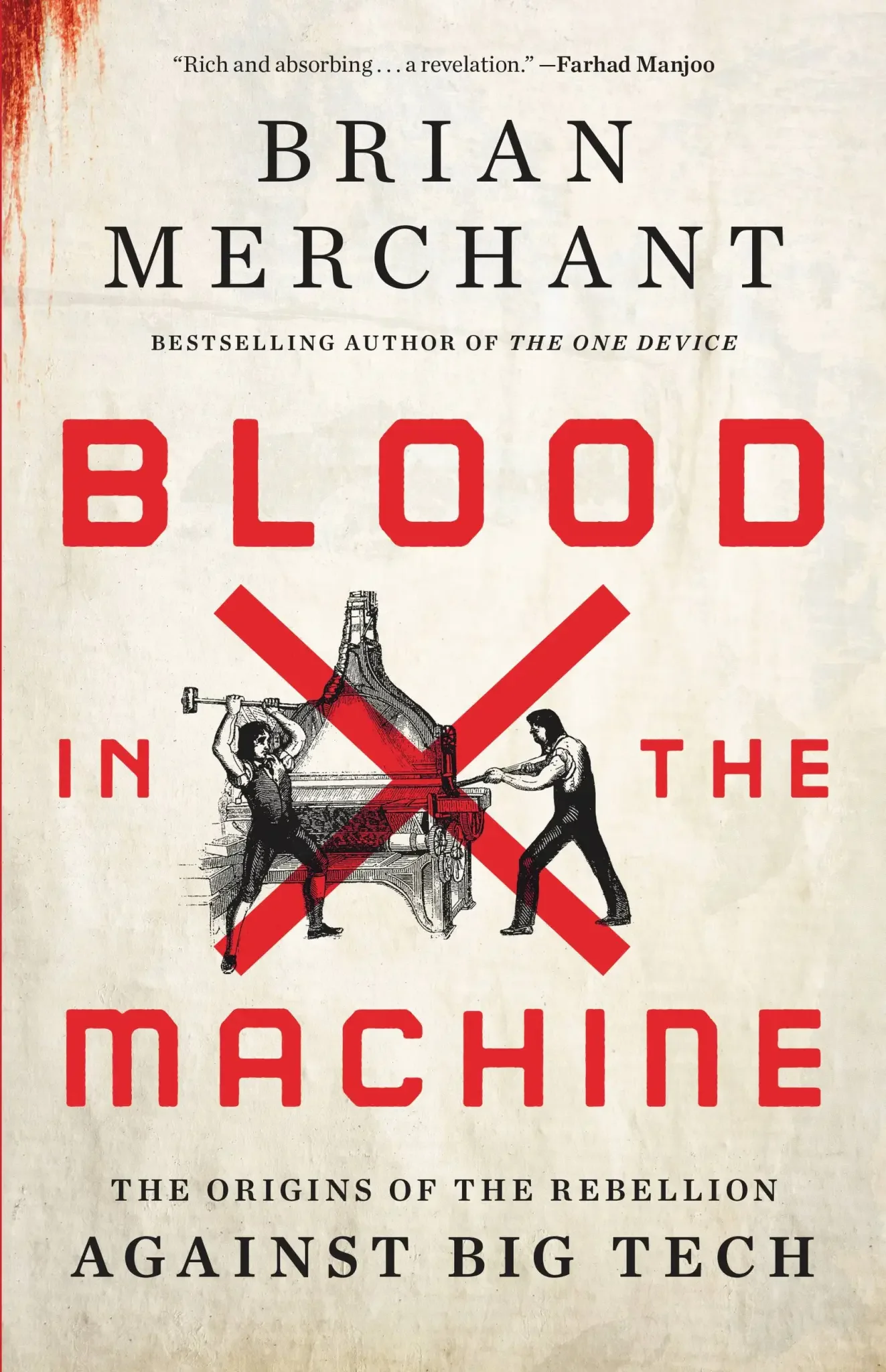
From the publisher
The most urgent story in modern tech begins not in Silicon Valley but two hundred years ago in rural England, when workers known as the Luddites rose up rather than starve at the hands of factory owners who were using automated machines to erase their livelihoods.
The Luddites organized guerrilla raids to smash those machines—on punishment of death—and won the support of Lord Byron, enraged the Prince Regent, and inspired the birth of science fiction. This all-but-forgotten class struggle brought nineteenth-century England to its knees.
Today, technology imperils millions of jobs, robots are crowding factory floors, and artificial intelligence will soon pervade every aspect of our economy. How will this change the way we live? And what can we do about it?
Related
📓 What the Luddites Really Fought Against: A concise history of what the Luddites actually objected to: not machinery itself, but the use of machinery to undermine skilled labor, wages, and established working practices.
🎧 Blood in the Machine — 99% Invisible: Brian Merchant and Roman Mars on the real history of the Luddites, how their reputation was transformed, and why Merchant sees parallels with today’s technology industry.
📄 Rethinking the Luddites in the Age of A.I.: Kyle Chayka considers Merchant’s argument that Luddism was fundamentally about worker power rather than opposition to technological progress.
📖 Breaking Things at Work by Gavin Mueller: A short history and defense of worker resistance to technologies used for surveillance, deskilling, automation, and control.
📄 How Textiles Repeatedly Revolutionised Human Technology: A broader history of textiles as a driver of technological change, including the machines and labor transformations that preceded the Luddite uprising.
📖 The Technology Trap by Carl Benedikt Frey: An economic history of automation that asks who benefits from technological change, who bears its short-term costs, and why those outcomes are shaped by political and economic power.
🎬 Charlie Chaplin — Factory Scene from Modern Times: Chaplin’s famous factory sequence turns mechanized labor, relentless speed, and the worker’s absorption into the machine into physical comedy.
🧵 The Lowell Offering and the Literature of the Lowell Mill Girls: Women working in the Lowell textile mills wrote and edited their own journal of fiction, poetry, essays, and commentary, leaving a rare firsthand record of industrial labor, women’s independence, and factory life.
📄 Wages Against Housework by Silvia Federici: Federici’s influential 1975 essay argues that housework is not outside the economy but essential to it, challenging the idea that unpaid domestic labor is simply a private or “natural” female responsibility rather than work.